Methodological workshops organized by the individual work packages took place in May, September, and October 2025.

Published 3. 12. 2025
Methodological workshops organized by the individual work packages took place in May, September, and October 2025.
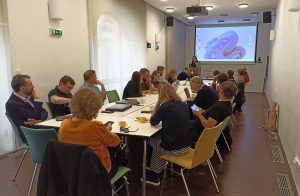
On 26 May, Work Package 3 held a workshop at the Academic Conference Center in Prague entitled Crisis, Its Impacts and Reflections in Urban Society in the Premodern and Modern World. The workshop focused on different forms of crises in urban history and their effects on urban society, economy, politics, and urban space. The discussion brought together topics from medieval, early modern, and modern history and demonstrated how crises—such as political conflicts, economic difficulties, fires, natural disasters, or energy crises—shaped the functioning of cities and transformed their social and spatial structures.
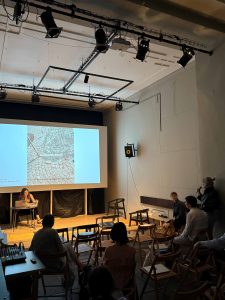
On 4–5 September, Work Package 1 organized the international workshop Understanding Public Space: Innovative Methods and Concepts for Interdisciplinary Research. The event took place at the Display Gallery in Prague and presented an overview of innovative approaches to studying public space and the issues associated with it at the beginning of the new millennium. The workshop introduced perspectives from urban history, participatory anthropology, sociology, social and digital geography, and artistic research, addressing topics such as the neoliberal transformation of postsocialist cities, digital mapping of public space, the acceleration of development projects, approaches to working with socially vulnerable groups, and urban gardening. The lecture program was complemented by an evening screening.
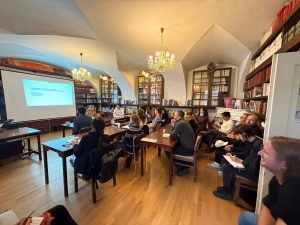
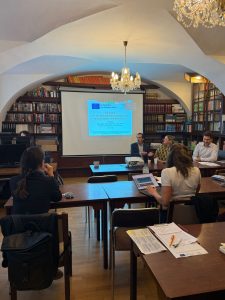
On 25–26 September 2025, a workshop titled Understanding Urban Inequalities in Dictatorship and Democracy (Perspectives and Narratives) took place in the reading room of the Institute of Contemporary History of the Czech Academy of Sciences on Vlašská Street in Prague. The workshop focused on different forms of urban inequality in Central Europe in the context of political regime changes from the twentieth century to the present. The program included contributions examining historical transformations of urban structures during the socialist and postsocialist periods, questions of security, exclusion, and property control in urban space, as well as perspectives from social geography on urban inequality. During the second day, researchers addressed issues of ethnicity and racially conditioned inequalities in urban environments, particularly processes of the ghettoization of Roma populations and the experiences of marginalized groups in Prague and other cities.

This result was financially supported by the The Johannes Amos Comenius Programme and is part of the research project "Urbanity: inequality, adaptation and urban public space in historical perspective", registration number: CZ.02 .01.01/00/23_025/0008735.
© 2026 urbanita.cz
Website created by: www.rinovo.cz